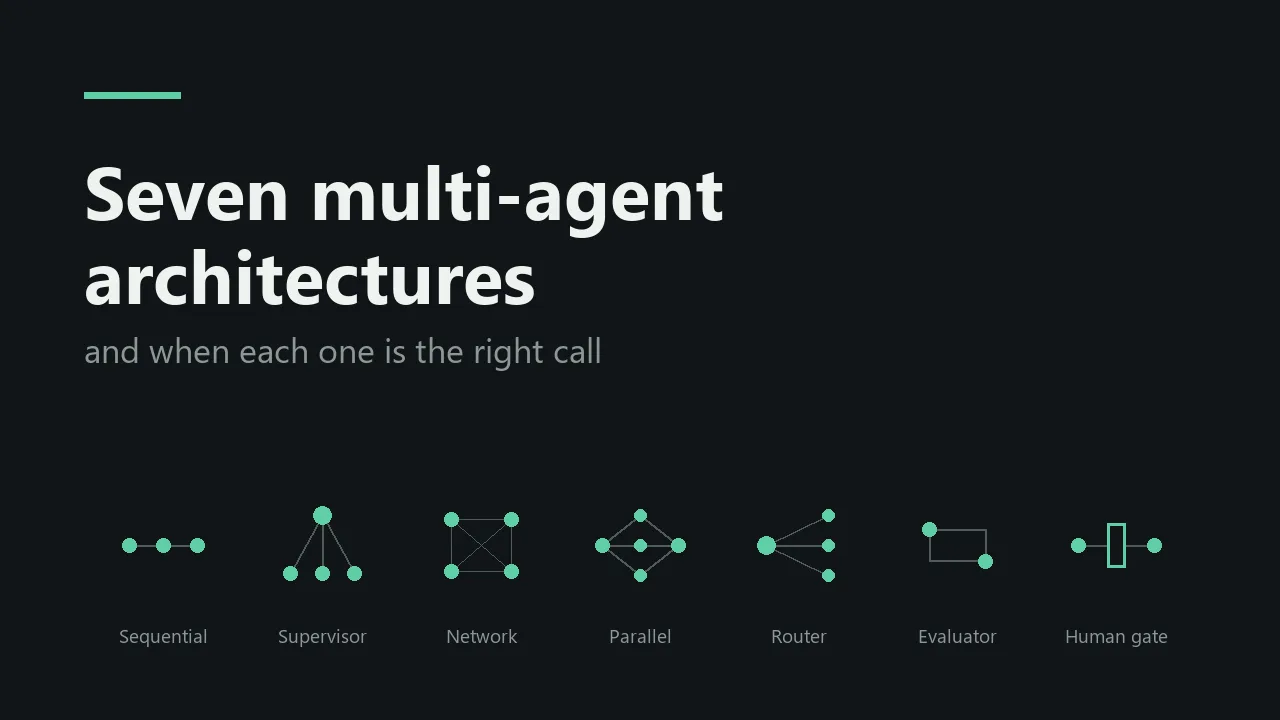
Seven multi-agent architectures, and when each one is the right call
Related post →
Everyone says multi-agent. Almost nobody says which one they mean.
Here are seven, and when each one is the right call.
1. Sequential
Agents run in a line and each one's output is the next one's input. One retrieves, the next filters and ranks, the last writes the answer.
Use it when the work has clear stages and each stage needs different expertise.
2. Supervisor
One lead agent breaks the request up, hands the pieces to specialists, and turns what comes back into a single answer. The specialists only ever talk to the lead, never to each other.
This is the right call when requests arrive in different shapes and no single prompt covers all of them.
3. Network
No coordinator. Agents message each other directly and decide between themselves who picks up what. More flexible than a supervisor but much harder to predict or debug.
Worth that debugging cost only when the path through the work genuinely cannot be known in advance.
4. Parallel fan-out
One agent, many copies, running at once over different slices of the same job, and a merge step that turns the pile back into one answer. Unlike a supervisor, the workers are identical and the interesting design problem is the merge.
Pick it when the pieces do not depend on each other and coverage matters more than depth.
5. Router
A cheap classifier reads the request first and dispatches it to the agent built for that kind of work. Nothing gets orchestrated and nothing gets merged, it is only sent to the right place.
Best when volume is high and most of it does not need your most capable path.
6. Evaluator and optimizer
One agent produces, a second one scores it against a standard, and the work loops until it passes. The evaluator has to judge on a different axis than the writer optimises for, or it will simply agree.
Add it when a confident wrong answer costs more than a slow one.
7. Human in the loop
The run stops before an irreversible action and waits for a person to approve, edit or kill it. The test is simple. If the agent can carry on without an answer, you do not have a gate, you have a notification.
Non-negotiable when the action sends, deletes, pays or publishes.
Most real systems are a mix. A router in front, a supervisor behind it fanning work out in parallel, an evaluator on anything that gets published, and a human in the loop on anything you cannot take back.
The names vary depending on who is writing. The shapes do not. Which of these are you running?